
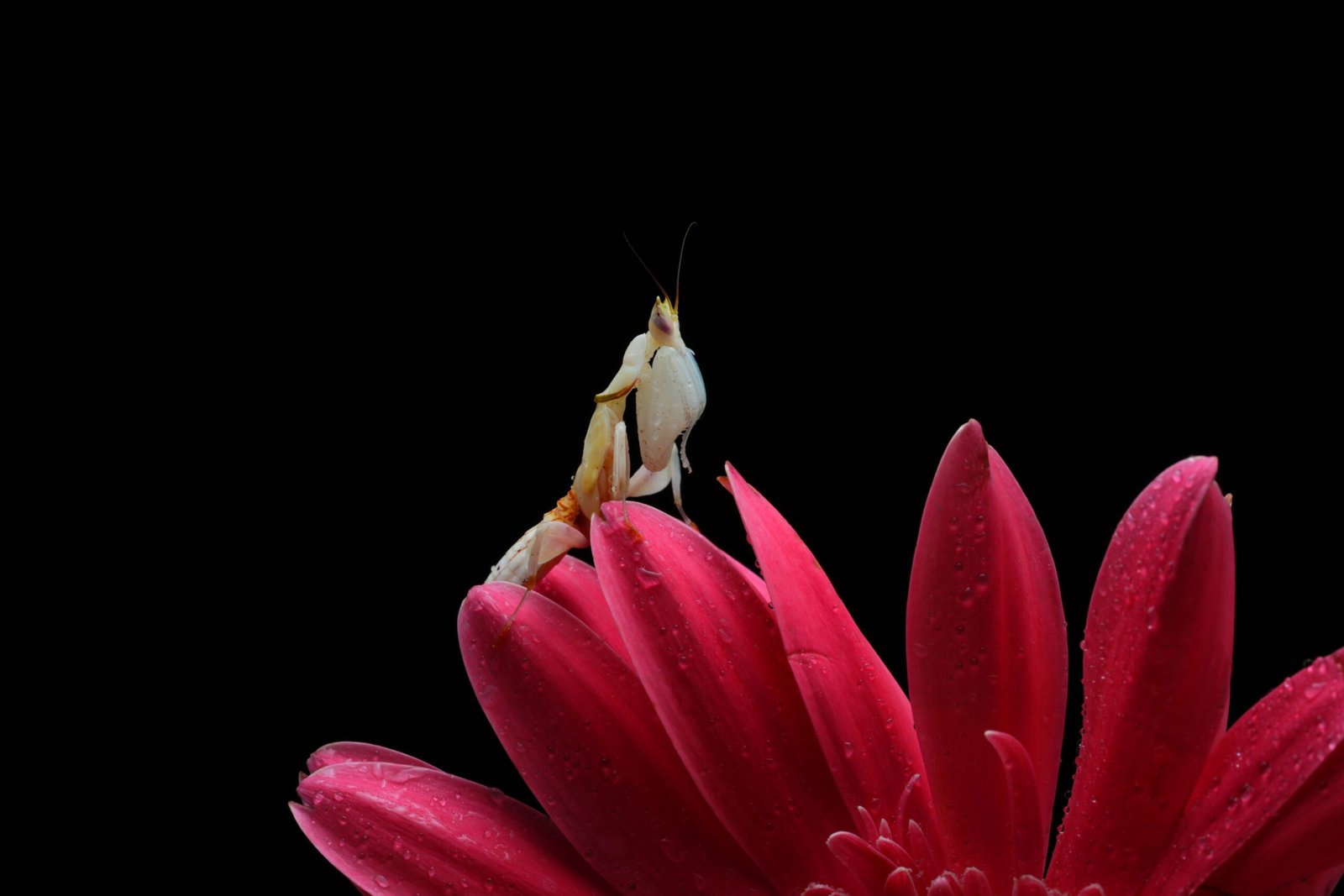
The orchid mantis (Hymenopus coronatus) is one of the most distinctive insects in the natural world. Its pale body, petal-shaped legs, and delicate pink or white coloring give it an appearance that resembles a flower. At first glance, an orchid mantis can look more like part of a tropical plant than a predator waiting to catch its next meal.
Adult females are especially striking. Their bodies are relatively broad, and the flattened extensions on their legs resemble flower petals. These features create a convincing floral appearance that can attract insects looking for food. The coloring is not always identical from one individual to another. Some appear mostly white, while others have noticeable pink, yellow, or cream tones. <Cite refs={[“turn689560search4″,”turn689560search7”]}/>
Male orchid mantises look quite different. They are much smaller and generally have a less conspicuous appearance, with darker or more muted coloring. This difference between the sexes is known as sexual dimorphism. In this species, the contrast is particularly noticeable because females are larger and have more pronounced flower-like features. <Cite refs={[“turn689560search0″,”turn689560search7”]}/>
The orchid mantis also has the characteristic front legs found in praying mantises. These legs are adapted to grasp prey, with spines that help hold insects securely once they are caught. Its other legs help it move around vegetation and maintain its position while hunting.
One reason the insect attracts so much attention is the contrast between its delicate appearance and its predatory behavior. It may look harmless while resting among leaves, but it is a specialized hunter capable of capturing other insects with a rapid movement of its front legs.
The orchid mantis is not a flower, nor is it a type of orchid. It is an insect whose unusual body shape and coloring have evolved to help it hunt. This combination of appearance and behavior makes it a fascinating example of adaptation in the animal kingdom.
Where Does the Orchid Mantis Live?
The orchid mantis is native to tropical parts of Southeast Asia. It is associated with warm environments where vegetation, humidity, and insect prey provide suitable conditions for survival. Scientific literature commonly identifies Malaysia and neighboring Southeast Asian regions as part of its natural range. <Cite refs={[“turn689560search0″,”turn689560search4″,”turn689560search21”]}/>
Its flower-like appearance is useful in habitats where insects regularly visit blossoms. Rather than depending entirely on hiding inside dense vegetation, an orchid mantis can position itself on a plant or other suitable surface where potential prey is likely to pass.
This hunting strategy depends on the relationship between the mantis and its environment. A location with abundant insects offers more opportunities to feed, while appropriate vegetation provides places to perch and wait. Tropical habitats also supply the warmth and moisture required by many insects.
The species is popular among insect enthusiasts, but its natural habitat is very different from a typical household. Anyone interested in keeping an orchid mantis should learn about its specific environmental requirements instead of assuming that a warm room and a small container will be sufficient.
Protecting the environments where orchid mantises live is also important. Tropical ecosystems support many interconnected species, including flowering plants, pollinating insects, and predators. Habitat loss can affect these relationships in ways that are difficult to reverse.
Because the species is associated with tropical regions, it should not be released into a local environment where it does not naturally occur. Releasing a non-native insect can create ecological and animal-welfare problems. People who keep exotic invertebrates should follow local regulations and obtain animals through responsible, legal sources.
What Does an Orchid Mantis Eat?
The orchid mantis is carnivorous, meaning it feeds on other animals rather than plants. Its diet consists mainly of insects, particularly those that visit flowers. Depending on the individual’s size and circumstances, potential prey may include flies, bees, butterflies, and other suitably sized insects. Research has documented the species attracting and capturing pollinators, supporting the idea that its floral appearance is an active hunting strategy. <Cite refs={[“turn689560search1″,”turn689560search2”]}/>
Unlike animals that chase prey over long distances, an orchid mantis often relies on patience. It remains still or makes small movements while waiting for an insect to approach. When prey comes within reach, the mantis uses its spiny front legs to seize it quickly.
This approach helps explain why the orchid mantis’s appearance is so important. Its body does not merely blend into the background in the way that a brown insect might blend into bark. Instead, its shape and coloring can resemble a flower that an insect might investigate.
A 2014 study published in The American Naturalist tested the long-standing idea that orchid mantises attract pollinators. Researchers found that their coloration was difficult to distinguish from that of nearby flowers from the perspective of certain pollinating insects. Field experiments also showed that isolated mantises attracted wild pollinators and captured them as prey. <Cite refs={[“turn689560search1″,”turn689560search9”]}/>
This makes the orchid mantis a remarkable example of what biologists call aggressive mimicry. In this form of mimicry, a predator resembles something that draws its prey closer. The resemblance is not simply a defense against being eaten. It can help the predator obtain food.
The mantis still needs to catch its prey successfully. A visiting insect may approach and escape, and the availability of prey depends on the environment. Nevertheless, its flower-like features provide an unusual advantage that distinguishes it from many other predatory insects.
How Does Orchid Mantis Camouflage Work?
The orchid mantis is famous for its camouflage, but its strategy is more unusual than simply hiding against a background. Many animals use colors or patterns that make them difficult to distinguish from their surroundings. The orchid mantis can instead resemble an attractive object, encouraging potential prey to approach.
Its appearance combines several features. Pale coloring can resemble the colors of flowers, while flattened extensions on its legs create a petal-like outline. The overall body shape contributes to the illusion, making the insect appear more flower-like than a typical praying mantis. Research on the species has examined how these characteristics influence the responses of pollinating insects. <Cite refs={[“turn689560search2″,”turn689560search4”]}/>
The hunting advantage is significant because pollinators often visit flowers while searching for nectar or pollen. If an insect approaches the mantis as though it were a flower, the predator may not need to chase it. It can remain in position and attempt to capture the visitor.
Scientists have also investigated how the orchid mantis’s appearance evolved. Research published in Scientific Reports suggests that predation played an important role in the development of the pronounced differences between males and females. The larger, more conspicuous females can take advantage of a wider range of prey, while smaller males have different demands because they must move around to find mates. <Cite refs={[“turn689560search7″,”turn689560search0”]}/>
It is important not to assume that every detail of the insect’s appearance is perfectly understood. Color, shape, habitat, and the visual abilities of prey all influence how mimicry works. Scientific studies continue to help explain which features matter most and how these adaptations developed.
The orchid mantis demonstrates that camouflage does not always mean disappearing. Sometimes, a predator benefits by being noticed for the wrong reason. Its appearance can encourage another animal to come closer, turning an apparently beautiful disguise into an effective hunting tool.
Can You Keep an Orchid Mantis as a Pet?
Orchid mantises are popular among exotic insect enthusiasts because of their unusual appearance and fascinating hunting behavior. However, they are not necessarily the easiest choice for a beginner. Their needs differ from those of common household pets, and responsible care requires research, appropriate equipment, and access to suitable live food.
Before acquiring one, learn about its adult size, feeding requirements, temperature and humidity needs, molting behavior, and expected lifespan from a reliable specialist care guide. Requirements can vary with the insect’s age and the conditions in which it is kept, so avoid relying on a single generic temperature or humidity figure without checking the source.
Housing and ventilation: The enclosure should provide enough vertical space for climbing and molting, along with suitable surfaces for the mantis to grip. Good ventilation matters because excessive moisture combined with stagnant air can create unhealthy conditions. At the same time, the enclosure must maintain the environmental conditions appropriate for the species.
Temperature and humidity: Orchid mantises come from tropical environments, so their care generally involves maintaining suitable warmth and moisture. Exact requirements should be verified using a reputable species-specific care sheet. Sudden environmental changes can cause stress, and incorrect conditions may interfere with molting.
Food: As insect predators, orchid mantises need appropriate live prey. Food should be suitable for the size and developmental stage of the animal. Avoid collecting potentially contaminated insects from areas treated with pesticides, and do not offer prey that is too large or dangerous for the mantis.
Molting: Like other mantises, orchid mantises grow by shedding their external skeleton. During a molt, the insect needs sufficient space and a secure surface from which to hang. Disturbing it during this process can cause injury, so the enclosure should be designed with molting in mind.
Handling: These insects are delicate and can be injured by falls or rough handling. Observation is usually preferable to frequent handling, particularly for inexperienced keepers.
If you decide to keep an orchid mantis, choose a reputable source and ask whether the animal is captive-bred. Check local rules regarding the possession, sale, importation, or transport of exotic insects. Never release an unwanted mantis into the wild.
Keeping an orchid mantis can be rewarding for someone prepared to meet its needs, but its beauty should not be the only consideration. A healthy animal depends on consistent, informed care throughout its life.
Orchid Mantis Facts, FAQs, and Final Thoughts
The orchid mantis combines an unusual appearance with a sophisticated hunting strategy. Its flower-like body has attracted the attention of photographers, naturalists, researchers, and insect enthusiasts around the world.
Quick facts about the orchid mantis
- Scientific name: Hymenopus coronatus
- Animal group: Insect, within the praying mantis order
- Native region: Tropical Southeast Asia
- Diet: Carnivorous, mainly insects
- Distinctive feature: Petal-like leg extensions and flower-like coloring
- Hunting method: Ambush predation and attraction of pollinating insects
- Male and female appearance: Females are substantially larger and more conspicuous than males
- Common interest: Wildlife photography, insect research, and specialist invertebrate keeping
Frequently asked questions
Is an orchid mantis real?
Yes. The orchid mantis is a real insect. Its scientific name is Hymenopus coronatus, and it is known for its resemblance to a flower.
Why does the orchid mantis look like an orchid?
Its coloring and petal-shaped leg extensions create a flower-like appearance. Research indicates that these features help attract pollinating insects, which the mantis can capture for food. <Cite refs={[“turn689560search1″,”turn689560search4”]}/>
Is the orchid mantis dangerous to humans?
It is a small insect predator that hunts other insects. It is not considered a serious danger to people, although any wild or captive insect should be handled carefully to avoid injury to the animal.
What colors can an orchid mantis be?
Individuals can show white, pink, cream, or yellowish tones. Color and appearance may vary with the individual and its developmental stage. Photographs can also make the colors look more intense than they appear in natural light.
Can an orchid mantis fly?
Adult males have wings and are generally more mobile than the much larger females. Flight ability and behavior can vary with sex and developmental stage, so it is best not to assume that every orchid mantis will fly in the same way.
Does an orchid mantis eat flowers?
No. Despite resembling a flower, the orchid mantis is carnivorous. It catches insects rather than feeding on petals, nectar, or plant leaves.
Can beginners keep an orchid mantis?
A beginner may be able to keep one with careful preparation, but the species has specialized environmental and feeding requirements. Learn about its care before acquiring it and choose a reputable, legal source.
How does an orchid mantis catch prey?
It often waits for an insect to approach, then uses its spiny front legs to grasp it. Its flower-like appearance can attract pollinators, bringing potential prey within striking distance.
Final thoughts
The orchid mantis is an extraordinary example of how evolution can produce adaptations that seem almost unreal. Its petal-like legs and pale colors make it look like a flower, yet those same features help it capture insects. Scientific research has shown that this resemblance can do more than hide the mantis: it can actively attract prey.
Whether you are interested in wildlife, insect photography, biology, or exotic pets, the orchid mantis offers a fascinating opportunity to learn about mimicry, predation, and adaptation. The more we understand how it lives and hunts, the clearer it becomes that its beauty is not just decoration. It is part of a remarkable survival strategy.


Leave a Reply